
Process and steps
The simplest risk management process that’s applicable to most organisational sizes:
- Risk Identification
- Risk Assessment
- Risk Management (Avoid, Mitigate, or Accept)
Step 1: Identify Risks
at board level: Board members must understand the following:
The organisation’s mission, values, and context:
- Who is our community?
- How have we promised to serve them?
- How do we do our work?
To develop the detail, questions to answer:
- The context, especially in relation to other players: what are funder expectations? What is the organisation’s capacity to meet those expectations? Who are our partners? Our champions? What are they doing?
- The challenges being faced at the operations level and, sometimes, at the programming and service delivery level.
- Good practices around audits (financial and otherwise).
- How other organisations function and adapt to their contexts, the risks and consequences they have faced; comparison can be useful tool to identify and assess risks.
at staff team level: Conduct risk assessment and make note of anything that appears unsafe or could pose a threat to clients, volunteers, staff.
- Are there processes in place if there is an incident? (fire exits, first aid kits, …)
- Are staff and volunteers properly trained on internal procedures related to safety incidents? (incident reports, reporting structures, …)
To develop the detail, actions to perform:
- Keep good records of what happens at the organisation and share them with the board
- Maintain an up to date risk register and record response strategy specific to risks.
- What are some of the challenges that staff and volunteers face?
- With the space?
- With meeting funding requirements
- and deadlines?
Step 2: Assess Risks
Assessment vs. Management: It’s impossible to avoid risk so instead we have to develop methods to assess and manage risk: make sure that we take all necessary steps to increase our chances of having positive (not negative) outcomes.
To manage risks: There are three key elements to managing risk:
- Avoid/transfer it
- Mitigate/lessen it
- Accept it
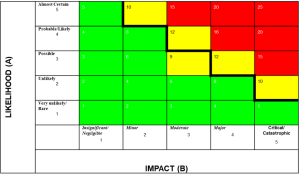
How risks are measured (RAG) rated: Likelihood vs. Impact, or could it happen, and would it hurt
Step 3: Manage Risks
Avoid/Transfer Risk: Create Risk Minimisation Policies:
- Addresses your policies and procedures to avoid such risk. Consideration for termination of services, projects, and/or activities that have a high likelihood and high impact on the organisation’s objectives.
- Reject engagement in high risk projects/services.
Insurance and Risk: the concept of liability Insurance related to the transference of risk; i.e. you share the risk with an insurance company. Libaility insurance:
- Protects your organization, board and staff
- Purchase charity insurance coverage from most insurance companies
- Get quotes from a number of different companies
Mitigate Risks: Create Risk Tolerance Policies:
- Addresses your appetite for risk (willingness) vs. your capacity for risk (ability to handle.
- Develop and test processes for assessing risk in your work: what do they look like? Who’s involved? How long do they take? What if it’s a crisis?
Tolerance for risk is dependent upon:
- Finances: do you have reserves? How much money do you usually bring in? Spend? How much can you lose/forego and still operate?
- Donor support, reputation, credibility
- Experience and competence of staff and volunteers
- Limits of Chief Executive Officers and/or Executive Director authority, information board should receive before making decisions
- Consider potential risk vs. Opportunity: what’s the worst thing that could happen and the best thing that could happen? How likely are each of these scenarios?
- Consider alternatives!